CampusMap
  Bibliothek
  Lern-/Aufenthaltsräume
  Rechenzentrum
  Webmail
  Ki-Hub
  Hochschulsport
  Stud.IP
  Online-Service
  Mensa
Mensa  Newsroom
  Pressekontakt
  Interne Verwaltung
 R123
R123
 R119
R119 Weitere Ansprechpartner*innen und Kontaktinformationen
 International Conference: Syntax Beyond the Canon - Focus on Functions
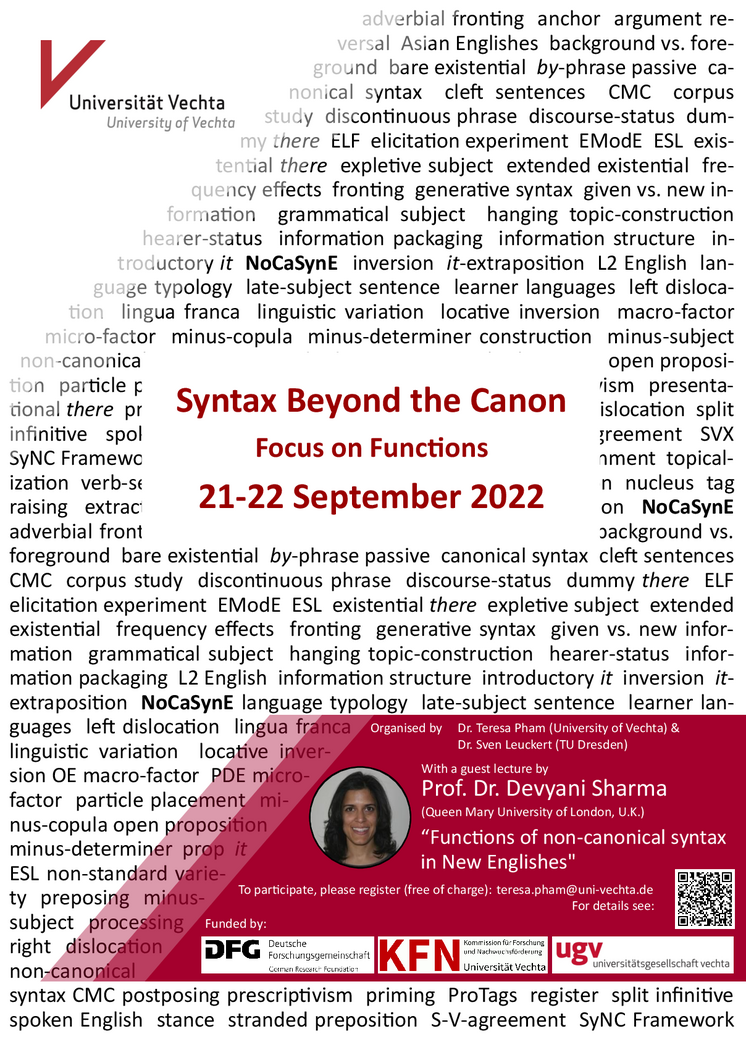
Organizers: Dr. Teresa Pham (University of Vechta) and Dr. Sven Leuckert (TU Dresden)
University of Vechta, Germany
20-23 September 2022
Format: On-Campus and Online Conference
Modern linguistics considers linguistic variation, including syntactic variation, as omnipresent in language use. But why would a language have several syntactic constructions with the same underlying proposition at its disposal? If there exists a default option, why would an alternative ever be used? Tom read the book exemplifies the default order of a sentence constituents in Present-Day English. However, a speaker may express the same basic meaning utilizing a quite different word order or construction: The book, Tom read (so-called fronting),It was Tom who read the book (a so-called it-cleft) and Tom, he read the book (a so-called leftdislocation) are just some of the options. Indeed, constructions like these are by no means marginal in frequency.
We define as canonical a default construction which under general circumstances will be chosen with the highest likelihood by a speaker or writer. A non-canonical construction, by contrast, is conceptualized as a syntactic construction which deviates from the default and is motivated by one or several factors. Since the 1960s, usage-based approaches have aimed to explain actual language usage and to uncover the factors conditioning linguistic and also more specifically syntactic variation and non-canonical syntax. Nevertheless, not all linguistic theories acknowledge(d) syntactic variation nor non-canonical syntax, nor do or did all studies incorporate it methodologically. And there is yet no consensus as to where and how to incorporate linguistic variation or non-canonical syntax into linguistic theory. Non-canonical syntax is thus still clearly underresearched in linguistics.
The Scientific Network “Syntax Beyond the Canon: Cutting-Edge Studies of Non-Canonical Syntax in English” unities ten linguists from Germany, the United Kingdom, and the Netherlands. It is funded by the German Research Foundation (DFG, PH-308/1-1) and was launched in 2019 (end of running time: 2024). All researchers who are part of this scientific network are interested in how, where, and/or why English syntax deviates from a default option (or, indeed, several default options).
The meeting in Vechta is the fourth of a row of six network meetings which are held at different international universities and discuss different aspects of non-canonical syntax. The aim of this fourth meeting in Vechta is to investigate the functions which non-canonical syntax in all its forms could and can perform, both in earlier periods of the English language and in contemporary World Englishes and registers of English. We are very much looking forward to the digital guest lecture by Devyani Sharma from Queen Mary University of London (U.K.) on Wednesday, 21 September 2022, 2pm, who will provide input on her area of expertise relating to non-canonical syntax, namely World Englishes. Furthermore, on Wednesday and Thursday (21 and 22 September 2022), the network members will present their research projects in 30-minute talks (each followed by a 15-minute plenary discussion) focusing on the different functions of non-canonical syntax as encountered in their different research projects. To enhance the visibility of the scientific network and the University of Vechta, the guest lecture and the presentations by the network members are open to a wider constituency of interested parties, i.e. students or colleagues from the University of Vechta as well as other universities.
The second part of the network meeting (Friday, 23 September 2022) will be devoted to network-internal concerns, especially to work on the final publication of the network with Cambridge University Press.
If you are interested in our topic or any of the presentations on 21 or 22 September 2022 and would like to join us either at the University of Vechta or online, please register with Teresa Pham (Teresa.pham@uni-vechta.de). Participation is free of charge.
For more information in the scientific network, see our website: https://sites.google.com/view/nocasyne/home
Preliminary Schedule (last updated 13 September 2022)
Confirmed keynote speaker:
Prof. Dr. Devyani Sharma (Queen Mary University of London, U.K.)
Other confirmed speakers:
- Dr. Gea Dreschler (Vrije Universiteit Amsterdam, NL)
- Prof. Dr. Sandra Götz-Lehmann (Universität Marburg)
- Dr. Christine Günther (Universität Hamburg)
- Dr. Sven Leuckert (TU Dresden)
- Dr. Theresa Neumaier (TU Dortmund)
- Dr. Louise Mycock (Somerville College, University of Oxford, U.K.)
- Dr. Teresa Pham (University of Vechta)
- Dr. Sofia Rüdiger (Universität Bayreuth)
The Scientific Network “Syntax Beyond the Canon: Cutting-Edge Studies of Non-Canonical Syntax in English” is funded by the German Research Foundation (DFG, PH-308/1-1).
The network meeting “Syntax Beyond the Canon – Focus on Functions” is further funded by the Kommission für Forschung und Nachwuchsförderung (KFN) and the Universitätsgesellschaft Vechta (UGV).