 CampusMap
  Library
  Computing centre
  Webmail
  AI Hub
  Univerity sports
  Stud.IP
  Online services
  Dining hall
  Newsroom
  Press contact
  Internal administration
A Science Shop for the region Oldenburger Münsterland
This is who we are
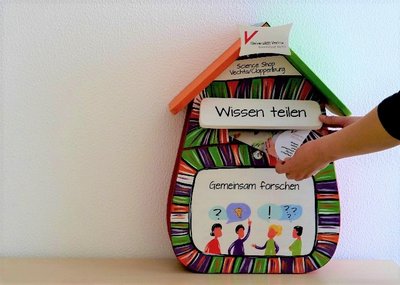
At Science Shop Vechta/Cloppenburg we build bridges to bring knowledge to life. As a regionally anchored science shop, we create spaces for dialogue, idea development and joint projects between science and society. Since 2012 our Science Shop is an institution of the University of Vechta in cooperation with the district of Cloppenburg. With our office at Bahnhofstrasse 57 in Cloppenburg, we provide a contact point for everyone
- who sees a potential research question in their concerns and wants to develop and answer it together
- who is looking for scientific support for a project idea
- who wants to contribute knowledge to current research projects
- or simply wants to gain an insight into scientific work
Our work is all about dialogue. We share knowledge from university with the wider community. But we also help to transfer the valuable knowledge and diverse experiences and observations of the the population into research. In joint projects with interested citizens, associations and organisations, municipalities and companies, we utilise and link different sources of knowledge in order to develop innovative and regionally fitting solutions for urgent social challenges - and put them into practice together. To accomplish this, we can draw on a wide range of methods and formats and a local, national and also international network that we have built up over the last ten years.
Become part of our community and contribute your questions and ideas to the projects of Science Shop Vechta/Cloppenburg!
Networking beyond the region
Science shops want to mediate between crucial challenges of society and citizens' questions on one hand and the scientific community and universities on the other. Knowledge should be provided for everyone so that all are able to take action accordingly and get involved in society. And science should investigate topics that concern society and contribute to solving problems. Science Shop Vechta/Cloppenburg works on these goals together with other science shops in Europe and beyond. We are a member in two science shop networks and frequently work together on projects with other science shops.



Hochschulnetzwerk Bildung durch Verantwortung (HBdV)
The goal of the University Network for Social Responsibility is to actively shape the social responsibility of universities, to enable partnerships between civil society organizations and universities, and to facilitate the mutual transfer of knowledge. Its focus areas include formats such as service learning, community research, social entrepreneurship education, campus-community partnerships, real-world laboratories and education for sustainable development. The University of Vechta has been a member of HBdV since 2024.
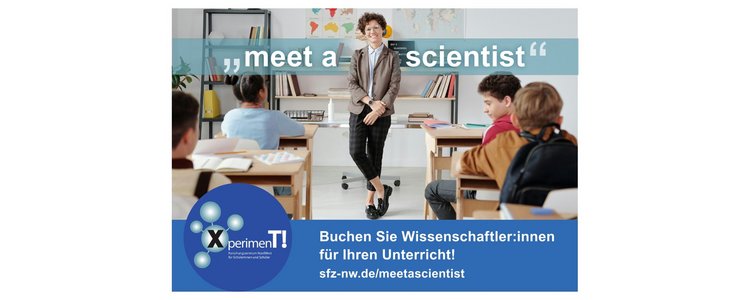
meet a scientist
University of Vechta and several other universities, universities of applied sciences and research institutions in the north-west of Lower Saxony are participating in the ‘meet a scientist’ programme organised by the Forschungszentrum NordWest association (‘XperimenT!’). On the online platform, teachers can book a lecture from a scientist for their class. The lectures tie in thematically with the topics covered in lessons especially in grades 5 to 13. In addition, the researchers talk about their careers and engage in discussions with the students.